Tis City Hall
Architect: Mohammadreza Soleimani
Project Type: Cultural, Office
Employer: Tis New City Development Company
Location: Tehran, Iran
Project Year: 2020
The main concern of the Tis project is the tension between past and future, which materializes in the present. In other words, the project’s aim is to create a phenomenon for the future whose roots lie in the past.
To create an urban landmark for a new city in a developing district that on one hand emerges from the region’s native and cultural patterns and has the potential to bring citizens together and create shared memories, and on the other hand is defined in harmony with the area’s geographical and climatic conditions.

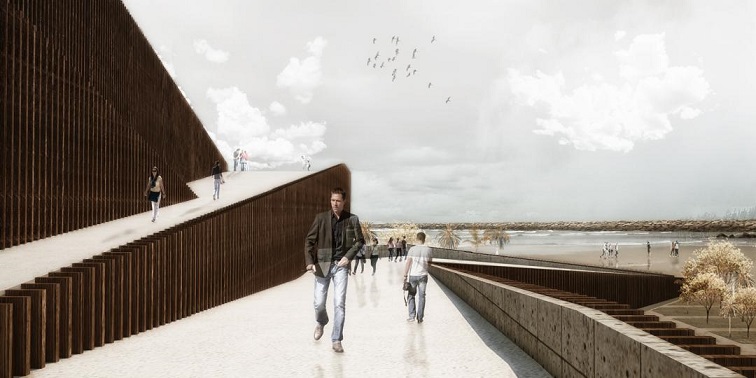
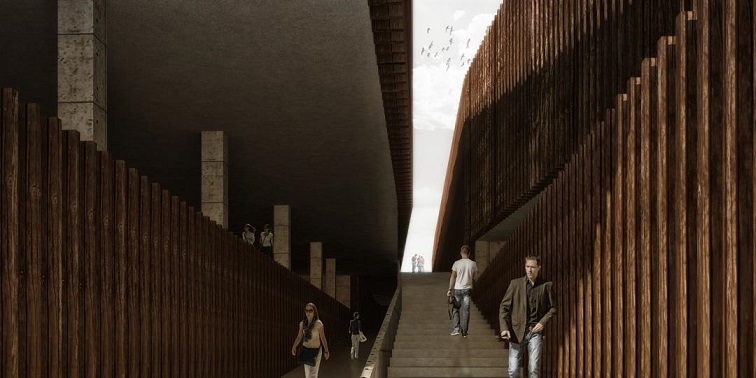
Accordingly, after fixing the halls’ locations from their initially floating position within the primary mass, maximum connectivity between interior spaces was established through continuous ramps, stairs, and elevators. Then, by making this mass permeable from multiple façades, the continuous internal flow was linked to the exterior space, completing a dynamic movement sequence from outside to inside and from inside to outside.
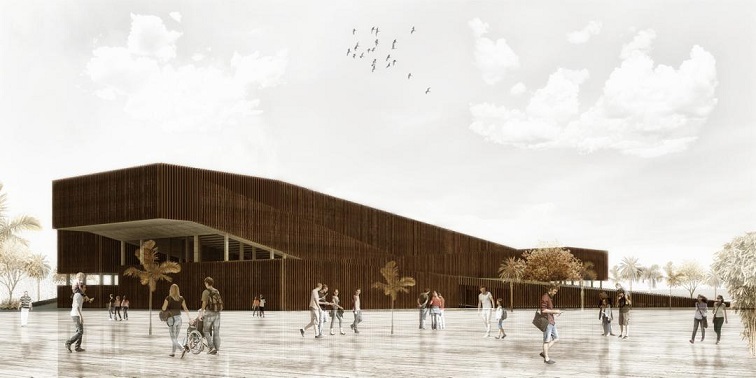
Thus, through a hierarchical sequence of transitions from the open exterior courtyards, the user arrives—via various entrances—at the semi-open covered exhibition or the entrance colonnade, and after passing through it enters the enclosed interior space.
Next, the user encounters an elongated lobby with continuous ramps leading to different levels, where—depending on the chosen program and the designated hall—they select their route. Along this path, until they reach the intended space, the user observes the flow of people moving to various halls on the different levels.
With the halls’ positions fixed and the exterior form completed and tied to the ground, continuous movement over the building’s roof will also be possible, which in fact reflects the continuity of movement inside the interior spaces.